Solar Energy
One of the biggest problems of modern day that effects just about every part of the world is growing industry, growing population and lastly the demand that has in turn increased the rate at which the people who inhabit the earth deplete it of resources. To keep living the way that we do in modern day our biggest weapon against this is by striving to implement sustainable practices that help to combat global warming and resource depletion. So, what exactly is sustainability? Well, according to the United Nations World Commission on Environment and Development (UNWCED) sustainability is defined as the “physical development and institutional operating practices that meet the needs of present users without compromising the ability of future generations to meet their own needs, particularly with regard to use and waste of natural resources”.[1] One of the biggest threats to sustainability is the construction industry, the end products and their impact on the environment post construction in relation to the energy they use or produce. This pertains to any construction project whether it be commercial buildings, civil projects, residential housing, and lastly the construction of renewable energy sources which happen to be the best way to achieve sustainability. Per the U.S Energy Information Administration renewable energy “is energy from sources that are naturally replenishing but flow limited; renewable resources are virtually inexhaustible in duration but limited in the amount of energy that is available per unit of time”.[2] This paper will be addressing renewable energy systems and their impact on the sustainability of the design field and construction industry. The systems that will be discussed consist of solar systems, and wind turbine systems.
To dive into solar energy systems we must first understand what it is. According to the U.S Energy Information Administration, solar energy is the process of converting solar radiation into useable energy. And this is done through the use of “solar photovoltaic” systems and solar cells that generally come in the form of solar panels.[3] The biggest pro of using solar energy as a renewable is that it does not produce any harmful waste and the biggest con is that solar energy is very inconsistent when looking at different geographical areas. For example, solar panels are an excellent source of energy in California due to the amount of sun present, and not as effective in Western Washington due to lack of clear days. The impact that solar energy as a renewable has on construction and design is becoming much more relative as solar panels are easy to include on a building or house in the form of solar roofs. Please refer to the "U.S. Energy Consumption by Energy Source" figure below for statistics relative to solar energy and other renewables for future reference.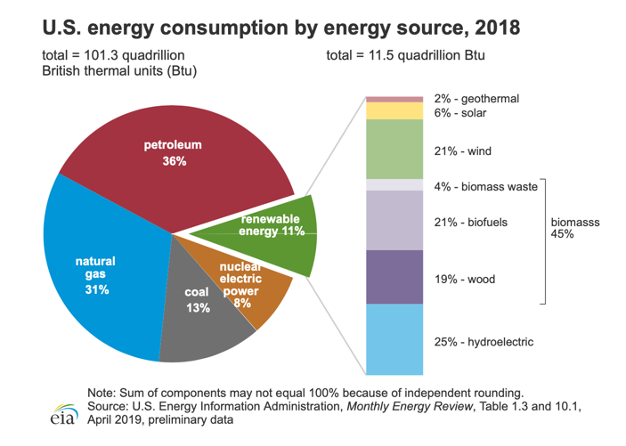
Wind Energy
The next renewable we will review is wind. In the figure to the right we can determine that this is one of the biggest sources of renewable energy used coming in at twenty-one percent. According to the U.S Department of Energy, wind energy or wind power “refers to the process of creating electricity using the wind, or air flows that occur naturally in the earth’s atmosphere”.[4]
There are three main types of wind energy and these consist of “utility-scale wind”, “distributed or small wind”, and lastly “offshore wind”. These different types all produce useable energy to same way with the main differences being size and location. These produce energies by using wind to blow through a turbine causing it to rotate, and the spinning of the turbine causes a gearbox to rotate producing mechanical energy.[5]
In relation to construction and design, wind power is seldom included in commercial, industrial, and residential construction. This is due to the fact that the wind turbines are massive and need to be in certain areas to be efficient. It would be highly unrealistic to put a turbine on top of an office building due to the nature of their design. Wind turbines fall into the category of civil construction and are generally located in low population density areas where wind currents are unaffected by manmade objects.
In conclusion, the construction industry has one of the biggest impacts of Earth’s environment, whether it be climate change or depletion of resources. In-order to continue living on this planet the one that we call home, we must take a sustainable approach. According to an article from the U.S. EPA archive, in 2005 buildings accounted for 38.9 percent of total U.S energy consumption, and buildings in the U.S. alone contributed to 38.9 percent of nation’s total carbon dioxide emissions.[6] Humans and their creations have caused an imbalance in our climate and this is a very pertinent issue and we can see the negative effects. Some of them being decreased air quality, melting polar caps and rising ocean levels. Our own creations also take energy to create and run, and before the use of renewables we were burning through forests and coal at a scary rate and this has still not stopped even though we know that it is in our best interest to. Whether it be solar, wind, hydro-electric, or nuclear renewable energy these are the best things to be considering when moving forward in the design field and construction industry and this is because if we don’t we will not be able to sustain our ways of life much longer and will in turn damage the potential of other species success and lives. Looking back it would also be in our best interest to invest more in solar and wind energy due to them both having no impact environmentally as nuclear renewables can be dangerous and carry a bad stigma while hydro-electric systems such as damn interfere with wildlife.
[1] Katz, N. (n.d.). What is Sustainability? Retrieved from https://www.sustain.ucla.edu/about-us/what-is-sustainability/
[2] U.S. Energy Information Administration - EIA - Independent Statistics and Analysis. (2019, June 27). Retrieved from https://www.eia.gov/energyexplained/renewable-sources/
[3] U.S. Energy Information Administration - EIA - Independent Statistics and Analysis. (n.d.). Retrieved from https://www.eia.gov/energyexplained/solar/
[4] Basics of Wind Energy. (n.d.). Retrieved from https://www.awea.org/wind-101/basics-of-wind-energy
[5] How Do Wind Turbines Work? (n.d.). Retrieved from https://www.energy.gov/eere/wind/how-do-wind-turbines-work
[6] Buildings and their Impact on the Environment: A Statistical Summary. (2009, April 22). Retrieved from https://archive.epa.gov/greenbuilding/web/html/
Visual Comfort
Assessment of Room 315
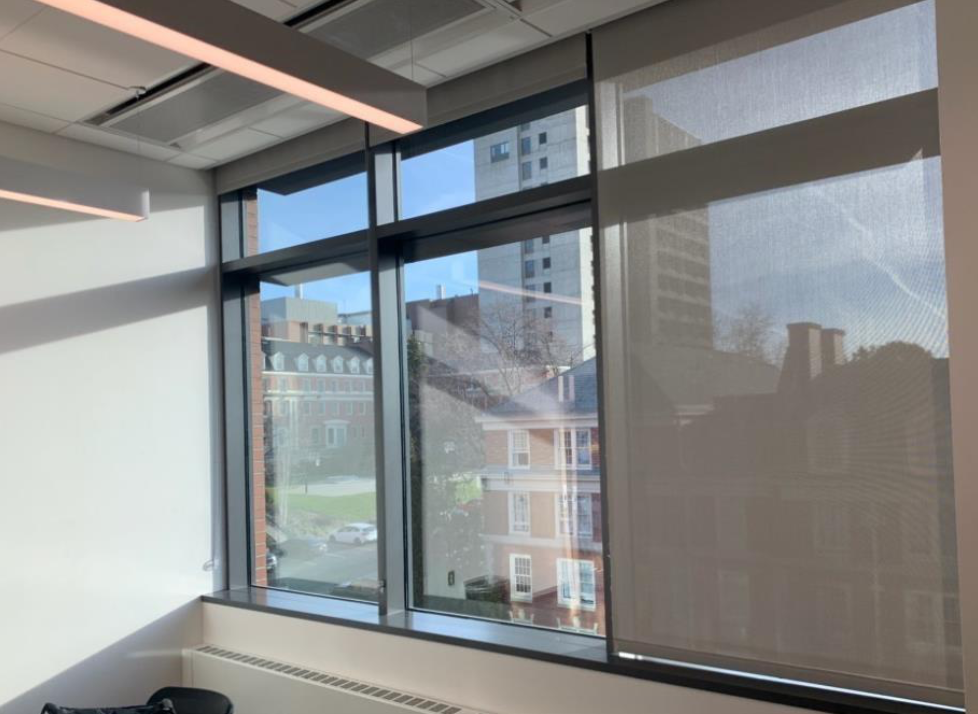
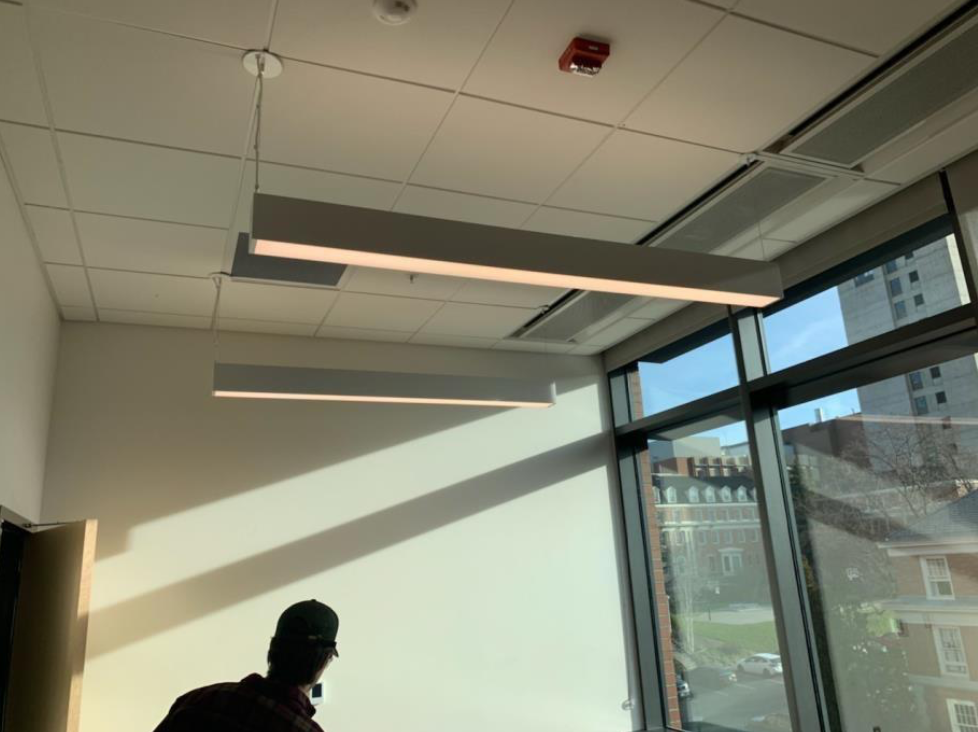
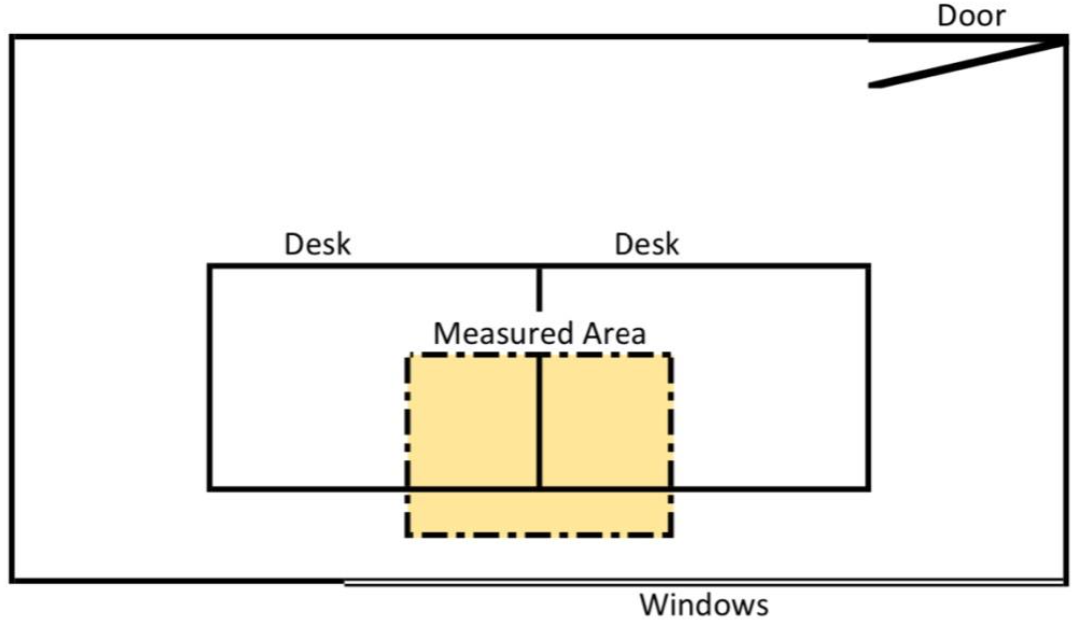
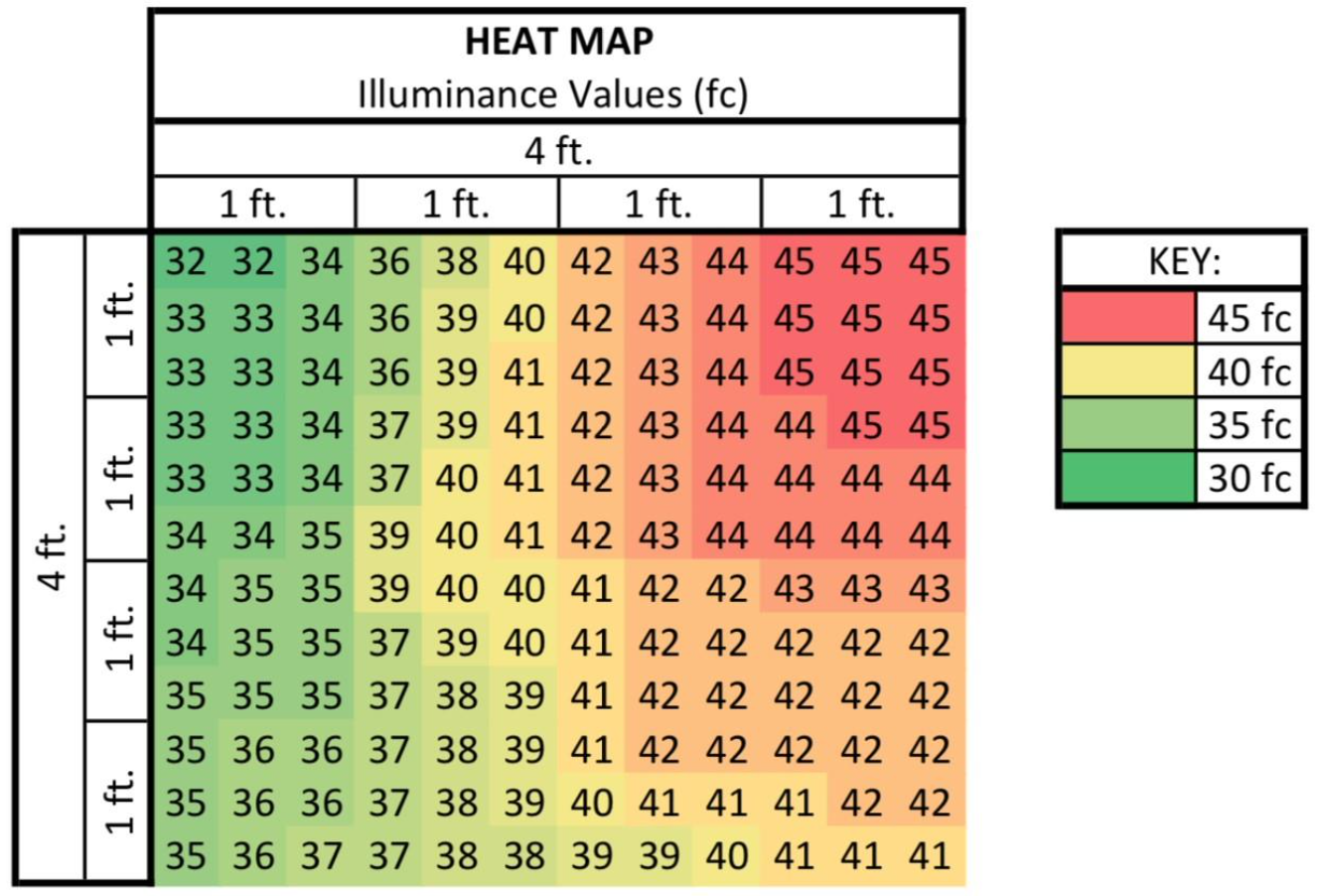
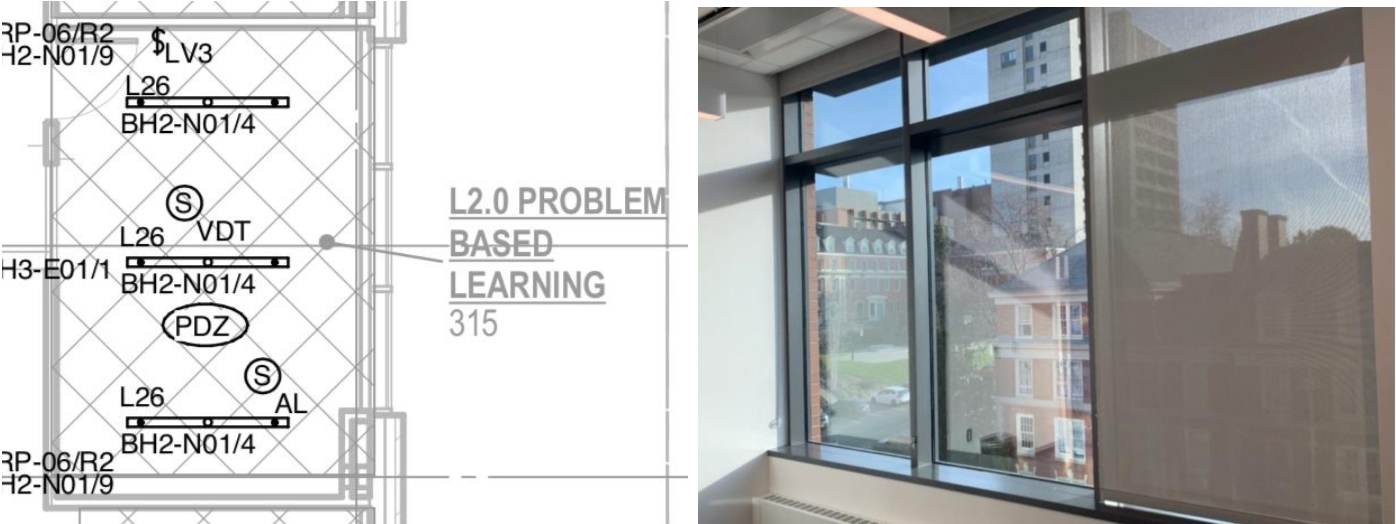
As shown in the pictures above, there are three large windowpanes each installed with light grey roller shades. One of those roller shades happened to be pulled down during the time our illuminance measurements were taken. The daylight that is being blocked from the roller shade is reflected in the Heat Map diagram. The 4’x4’ measured area shown in the Floor Plan Layout, includes a zone shaded by the roller portrayed on the left side of the heat map. As you can see in the illuminance measurement below, there is a lesser measure of illuminance (fc) in that area, compared to the right side of the measured region where there was no roller shade blocking the daylight.
The study rooms’ East facing windows produce large amounts of daylight. To dampen the amount of daylight entering the room, each window is complete with gray roller shades. As shown in the images above, the roller shades are efficient in blocking direct sunlight, while still allowing a soft amount of light to pass through.
The walls in the study room are white which allows light to reflect very well, except for the west wall which is a pale blue. The choice of color in this room allows good illuminance that is not too harsh, as that is the wall that will receive the most daylight from the sun. Because of the amount of direct sunlight in the room, the matte finish on of the paint on the walls helps reduce the glare. Another positive, presumably since this is a new building, is the light sensors were motion detectors so that allows energy saving when not occupied.
Improvements for Room 315
To reduce the harshness of the daylight in this room, an option is to paint the west and north walls a slightly darker shade than the current pale blue, possibly just a darker shade of blue. To combat the daylight bouncing off the roof out of the window is finishing it with black so that you didn’t have to choose between having the shades closed or being blinded when studying.

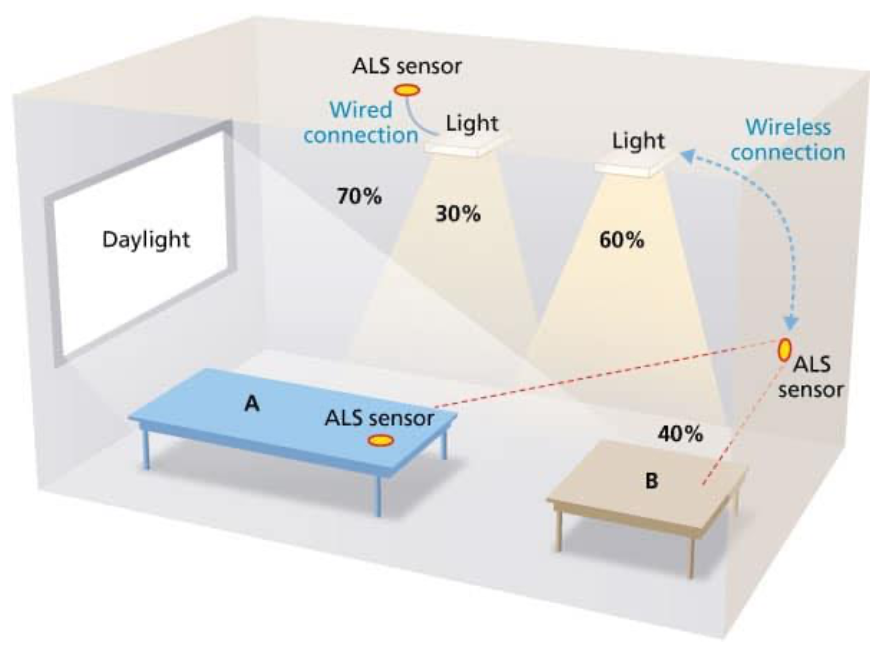
One thing that was noticed about the motion sensor switches in this study room is that they turned on as we entered the room, as they should. But the daylight from the sun on that East face of the building was so bright that the suspended fixtures were ineffective in providing any light. One solution to this situation could be the installment of an ambient light sensor system in the East facing rooms of the building. An ALS system (shown below) measures the amount of light on specific surfaces and can adjust the amount of light produced by the lighting fixtures. This would reduce the power used and needed during times that the sunlight is too bright for the suspended light fixtures to be effective at all.
Building Controls
Existing Lighting & Daylight Controls
Wall box dimmers (26 09 23)
Wall and ceiling mounted occupancy sensors (26 09 23)
Ambient light sensors (26 09 23)
Sensor power packs (26 09 23)
Low voltage switch (26 09 23)
UL 924 Emergency bypass/control devices (26 09 23)
Time Clocks (26 09 23)
Automatic transfer switches - 3 phase (26 36 23)
Surge protective devices (26 43 00)
Roller window shades (12 24 13)
Proposal #1 - Study Rooms @ East Face
On both the second and the third floor of the Spark building, there are two study rooms located on the east side of the building. These study rooms receive large amounts of direct sunlight through its tall windows.
Current System:
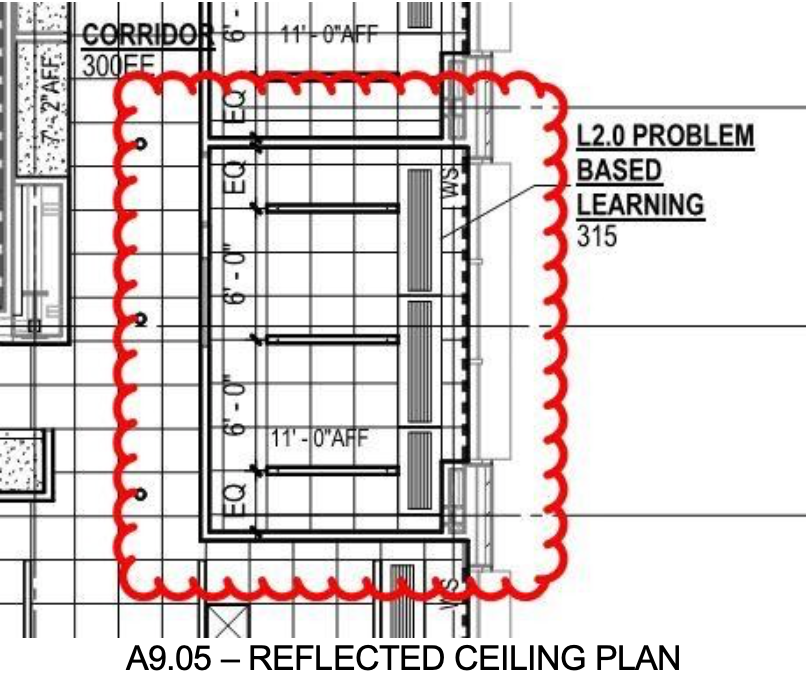
The current lighting controls in place in the study rooms are roller shades over each of the windows, three suspended track light fixtures, and a motion sensor light switch with on/off switches. The roller shades have proven very effective for their purpose of blocking daylight as shown in the image below. The light fixtures were suspended 24” from the ceiling with direct/indirect luminaires for use with 875 lumens/ft downwards and 375 lumens/ft upwards. Each of the study rooms and many of the classrooms are equipped with motion sensor switches and occupancy switches, which can both save large amounts of energy in comparison to traditional on/off light switches. Motion sensor switches can automatically turn the lights on or off, or both. Occupancy switches turn the lights on when you enter the room, and once you leave the switch waits a preset time before turning the light off automatically.
Proposed “Value Added” - Ambient Light Sensor System
During the morning hours when the sun is shining from the east, the motion sensor switches in these study rooms will turn on. This is the proper function of these sensors, however, the daylight from the sun on that East face of the building was so bright that the suspended fixtures were ineffective in providing any light. One solution to this situation could be the installment of an ambient light sensor system (ALS) in the East facing rooms of the building. An ALS system (shown below) measures the amount of light on specific surfaces and can adjust the amount of light produced and brightness displayed by the lighting fixtures. This would reduce the power used and needed during times that the sunlight is too bright for the suspended light fixtures to be effective at all. In addition, ALS systems have other benefits; cheap and simple to install (particularly wireless systems), very user-friendly, extremely convenient, long battery life when wireless due to low power consumption, and also help with health and safety requirements.
Proposal #2 - Active Learning Classroom (Room G10)
The Active Learning Classroom is one of the largest sized classrooms in the new Spark building and has large windows on the South and West-facing walls. These large windows provide over 750 SF of transparent surface space for the sun to shine through, with 680 SF of it on the Southern wall meaning it will have daylight shining in at all times of the day.
Current System - Roller Window Shade
The current system of daylight control for this room consists of motorized roller window shades which definitely have a few minor flaws. Our project team believes that this system can absolutely be improved upon. The first flaw in this motorized daylight control pertains the the amount of upkeep that is needed to maintain these systems. These windows stretch from finish floor (FF) to the ceiling, almost 23’ above finish floor (AFF) and so the rolled shades must be cleaned regularly to avoid dust build-up and keep the air well ventilated. The next problem is that someone has to manually press a button to lower the blind - now that in of itself is not difficult, but the purpose of an automated system, like the one we are proposing, is to take all human interaction out of the equation and allow the system to run with minimal energy requirements. Which brings me to my next point, reducing energy costs. If you can eliminate all energy costs, why wouldn’t you? Our system proposal is not only completely automated and energy free but will also save in the long run in maintenance expenditures.
Proposed “Value Added” - Transitional Window Shade
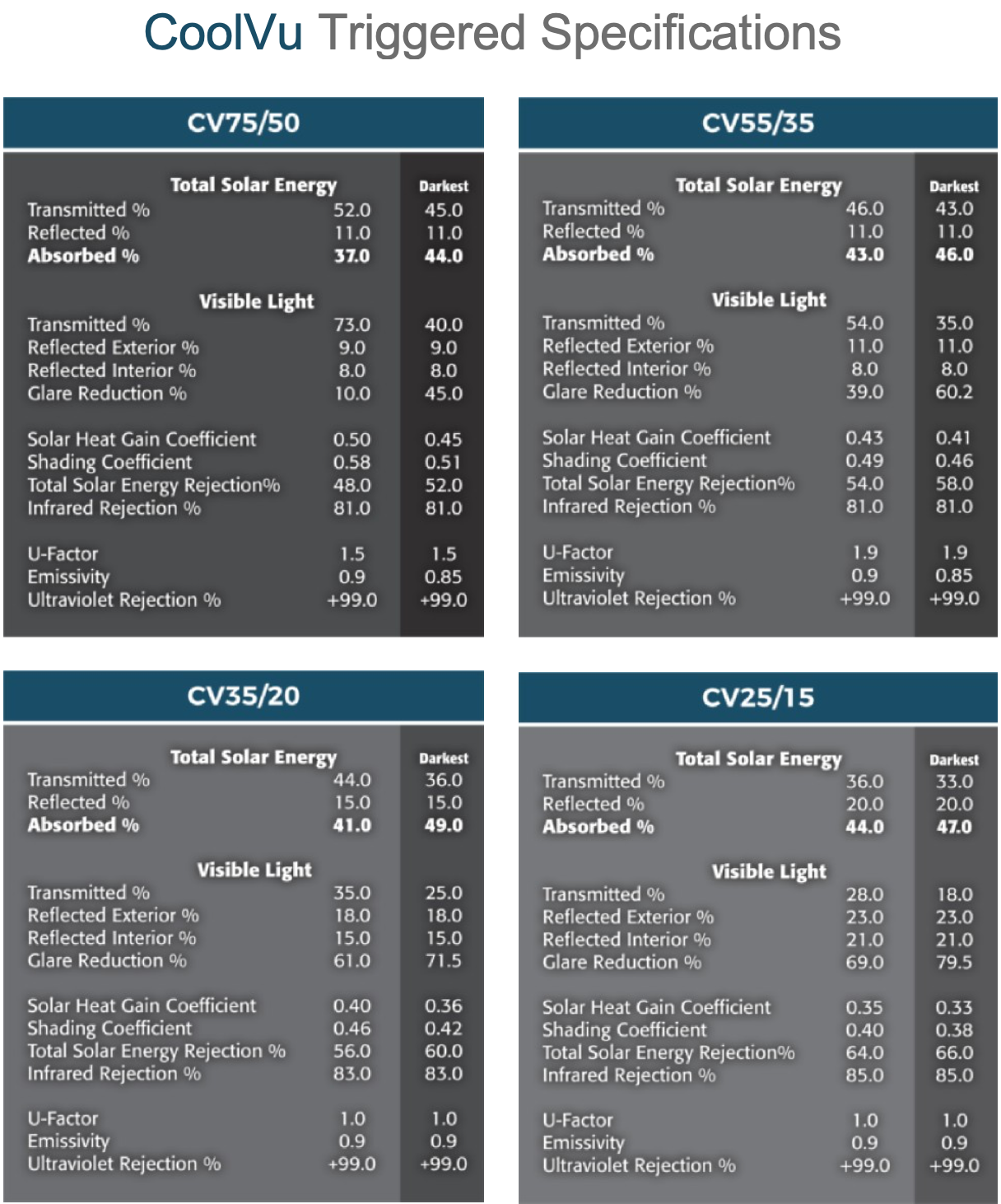
Our proposal consists of using window film provided by ‘CoolVu’. This product is a transitional window shade system designed to dim when daylight is more intense. There are four options to choose from with the weakest transmitting 73% visible light to 40% at its darkest and the strongest transmitting 28% to 18%. This system eliminates all problems pointed out in the roller window shade system as it does not require cleaning, is automated by the intensity of daylight, and has no energy requirements for it to activate. Another bonus for transitional window shade is that it is a sliding scale meaning that it doesn’t have to be at the lightest setting or the darkest, it fits best to how bright the daylight is, unlike the roller shades which are either up or down, light or dark and no in-between. Please refer to the data tables and specifications on the next page for more information about ‘CoolVu’.
Note: our recommendations are based on the idea that they can be implemented throughout the entire building. While the study analyses are based on two specific rooms, it is our belief that they are fitting improvements for all rooms of similar styles.
Acoustics
Problem Definition & Analysis - Study Rooms @ East Face
On both the second and the third floor of the Spark building, there are two study rooms located on the east side of the building. It is immediately apparent that there are acoustical issues that arise when using any one of these study rooms. The biggest acoustical issues that come with using these rooms is the sound that travels into the room through the hallway and it can be especially loud between passing periods when there are large amounts of foot traffic. These rooms are identified as study rooms and therefore this should not be an issue.
The reason the sound is able to travel from the hallway into the room comes down to two variables. These consist of the type of door that is used, along with the insulation used at the frame. Secondly, the large section of the West wall of the study rooms are made up of glass instead of a normal wall that would have insulation and barriers that would inherently block out sounds generated from outside of the study rooms.
Statement of Acoustic Design Intent:
To achieve our desired intent for the acoustics of the study rooms previously mentioned, our company believes the best direction would be to replace the door with a heavier door that has a better acoustical rating. We also believe that instead of having a window on theWest wall, it would be better to just use the same wall that is used in the rest of the room.
Summary of Research and Solutions
Creating a quiet study room should be a relatively easy objective to accomplish with today’s technology. Based on our research we have determined three ways to improve the acoustical problems in these study rooms. They are: using a better acoustical insulator material in the walls, removing the window and replacing it with a wall that has the upgraded insulator, and finallychoosing a better door that further decreases noise from the hallway.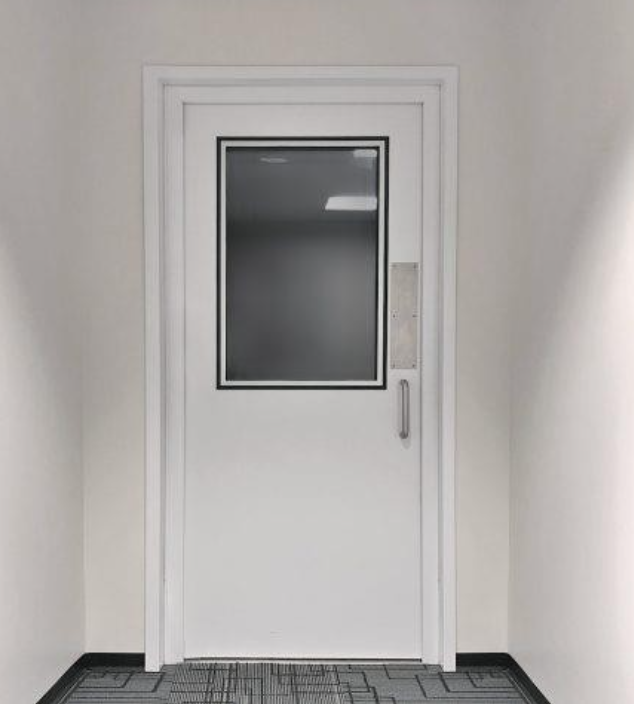
The door will be the most expensive solution in our proposal and we have chosen the IAC Acoustics Noise-Lock Door from Acoustical Solutions rated at STC 64 - their highest rated door. The door offers a tight seal around the frame with many different thicknesses and materials to satisfy desired aesthetics. With the window being removed for a wall, one might worry that there is now only one window which could make you feeltrapped in the room; but with this door, it has the option of adding in glazing without reducing the effectiveness and it can come clear or opaque. The use of this door will go a long way in making any study room as acoustically tight as possible.
The window is arguably the worst part of keeping this room tight acoustically, plus it offers no privacy to the people studying which can be distracting, so removing it and continuing the wall through the space is the best option. This also does not negatively affect the room in any way as it does not decrease the daylight and if you’re worried about feeling trapped, you can add the glazing option in the door as mentioned above. Combine that with the light blue paint that was previously chosen for the room, it still feels warm and inviting while being a better work area.
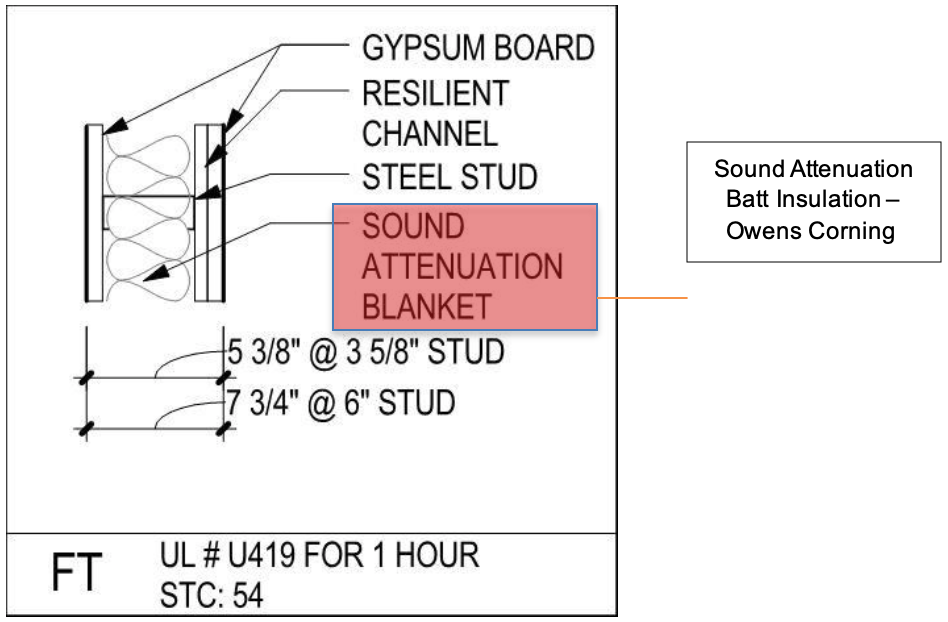
Finally the in-wall acoustical insulation. We are recommending the Sound Attenuation Batt Insulation from Owens Corning implementing the double layer wall system for gypsum board walls. This increases the STC by 2 for the entire wall system including thenew wall area that was previously a window. While this increase of STC 54 to 56 does not seem like a lot, adding it through the entire wall system will make a remarkable difference when combined with our other solutions.
With these changes, the door becomes the most well-secured spot for stopping sound ata rating of STC 64 and the walls are at STC 56. As per module 9 “Where we are most sensitive, in the range of 3000 to 4000 Hz, we can hear sounds even at –5 dB. The upperlimit for loudness is 120 to 130 dB.”1 and based on the door specs shown below, at a 3150Hz, the door only transmits 70 Db as a single leaf door, with the option of being a double leaf door available making it more effective. The walls, being rated at STC 56 do not comewith technical specs defining the decibels at specific frequencies but they cannot beextremely different from our door selection, making this one of the most sound-proof options available.
This analysis and improvements on the third floor study rooms can be used for all rooms of similar format and style. Any and all study rooms throughout the Spark building can greatly be improved by more privacy and better acoustic insulation.
-
com. (n.d.). IAC Acoustics Noise-Lock Door.
https://acousticalsolutions.com/product/iac-acoustics-noise-lock-door/ -
com. (n.d.). Ecotouch Sound Attenuation Batts.
https://www.owenscorning.com/insulation/products/ecotouch-sab
1 Day, J. (n.d.). Module 9 - section E - subsection a. Retrieved April 14, 2020, fromhttps://learn.wsu.edu/webapps/blackboard/execute/displayLearningUnit?course_id=_242254_1&content_id=_3889432_1
Reflected Ceiling Plan
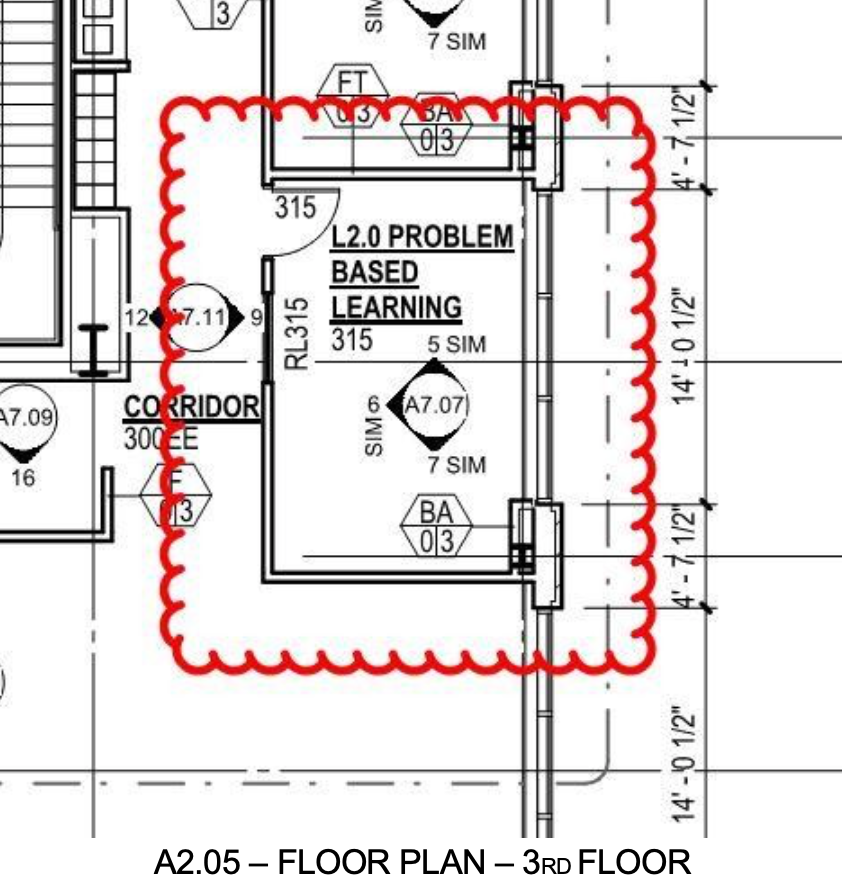
Floor Plan – Room 315
West Wall Elevation – Room 315
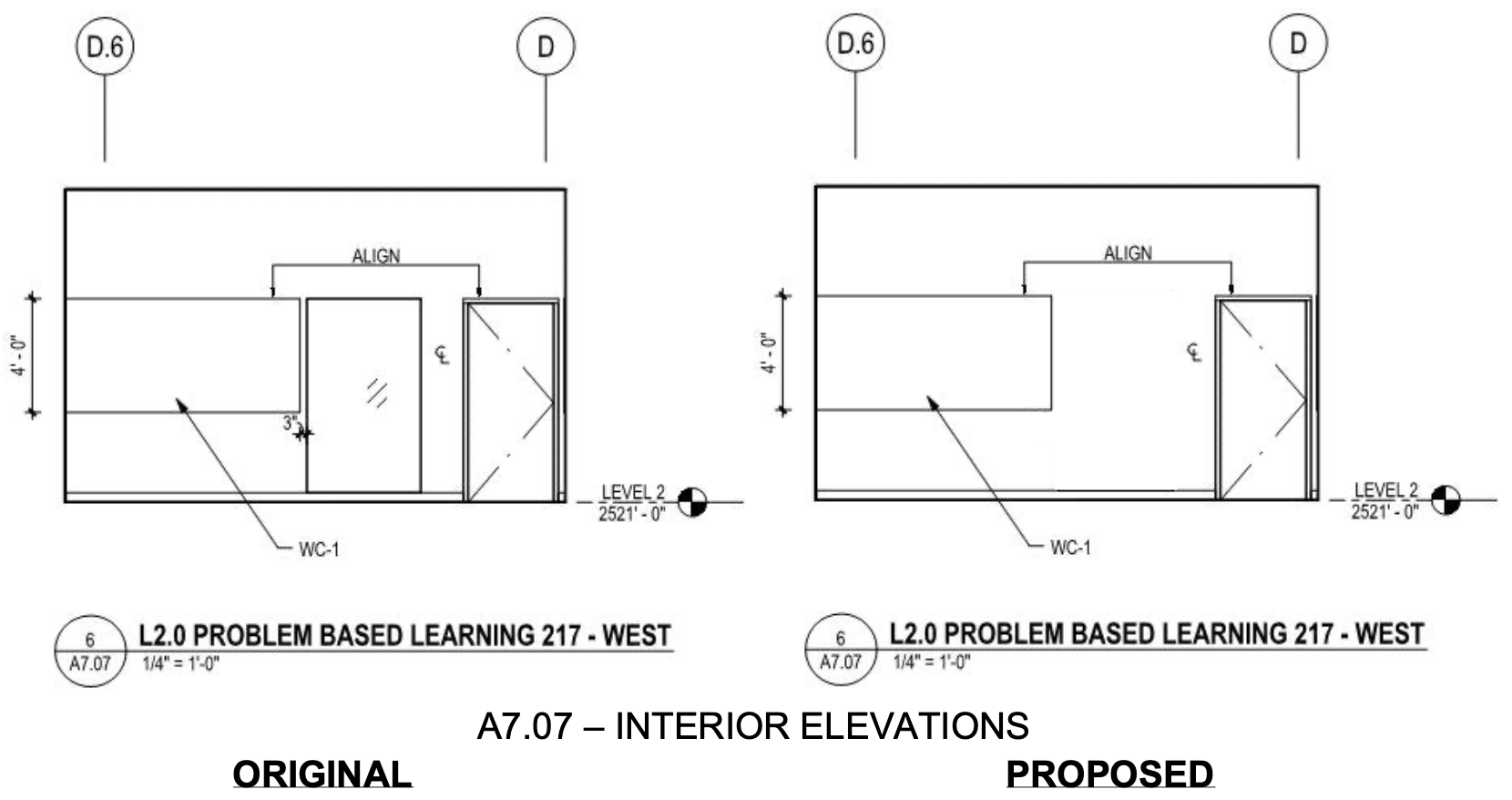
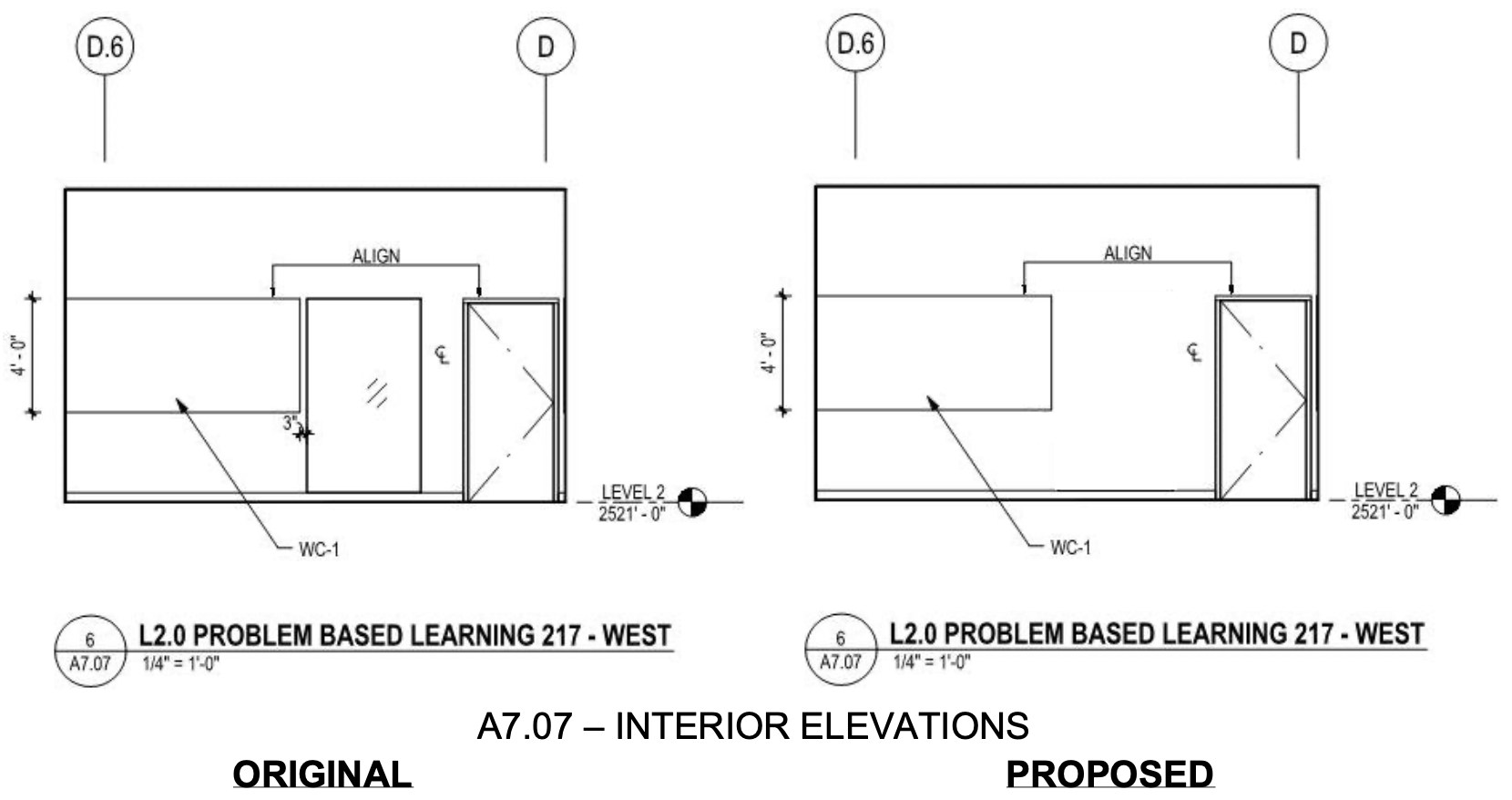
As shown in the elevations above, the original plan shows a large window adjacent to the door of room 315 in the Spark building. In order to improve acoustics in the room and block outside noise, our company is proposing the new plan shown on the right in the above elevations. This proposal extends the FT03 wall all the way through to the door, eliminating the interior window completely.
FT03 Wall Detail
Spatial
System Grade: A
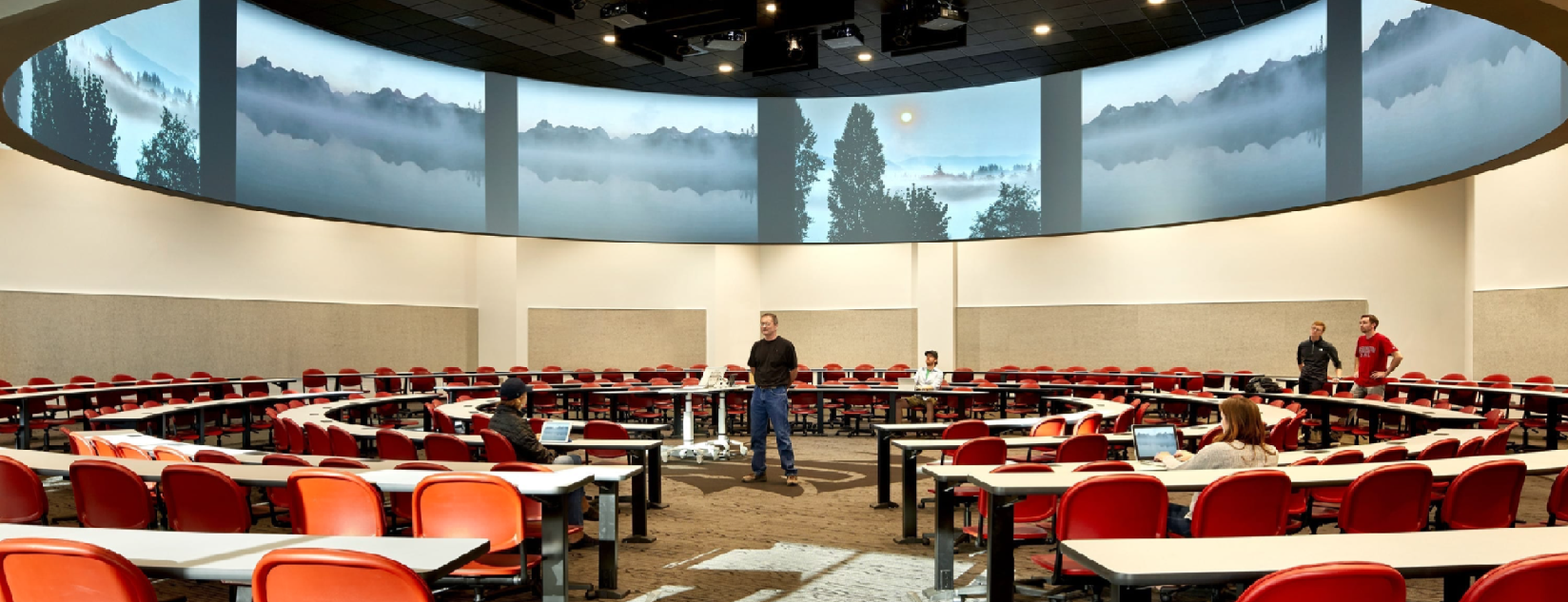
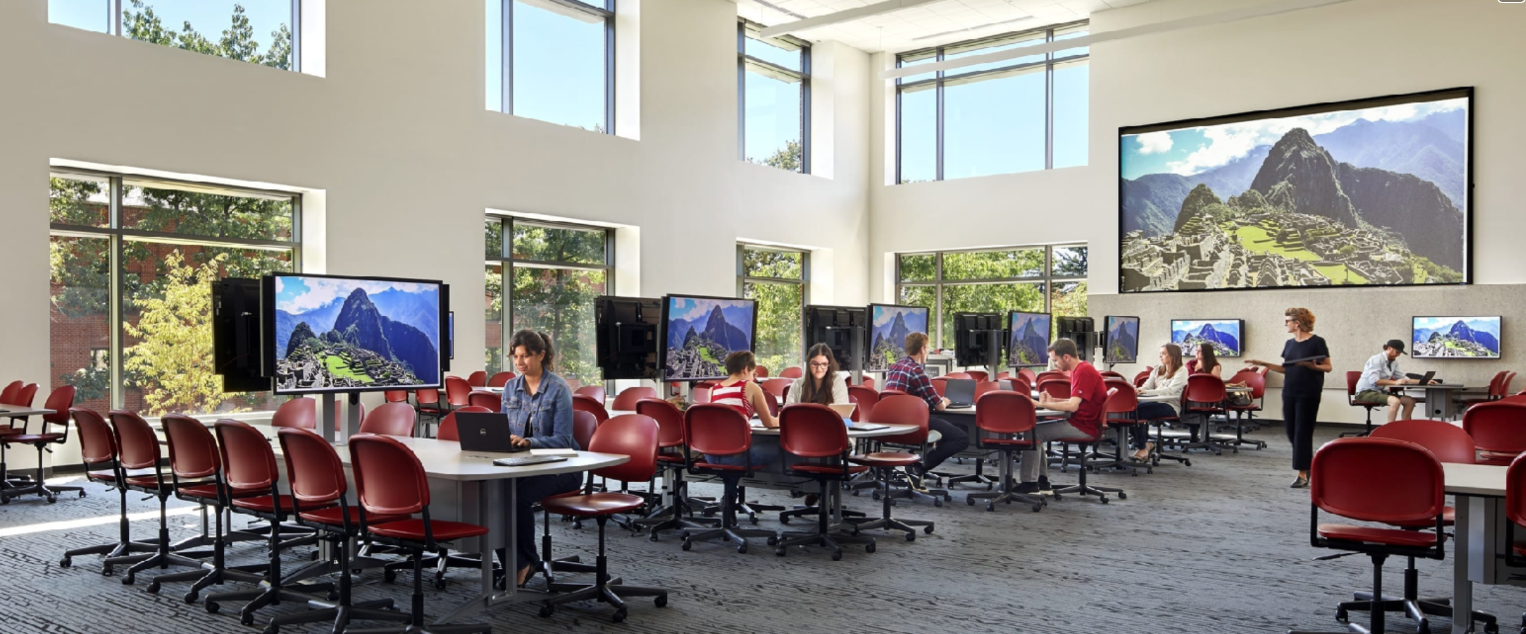
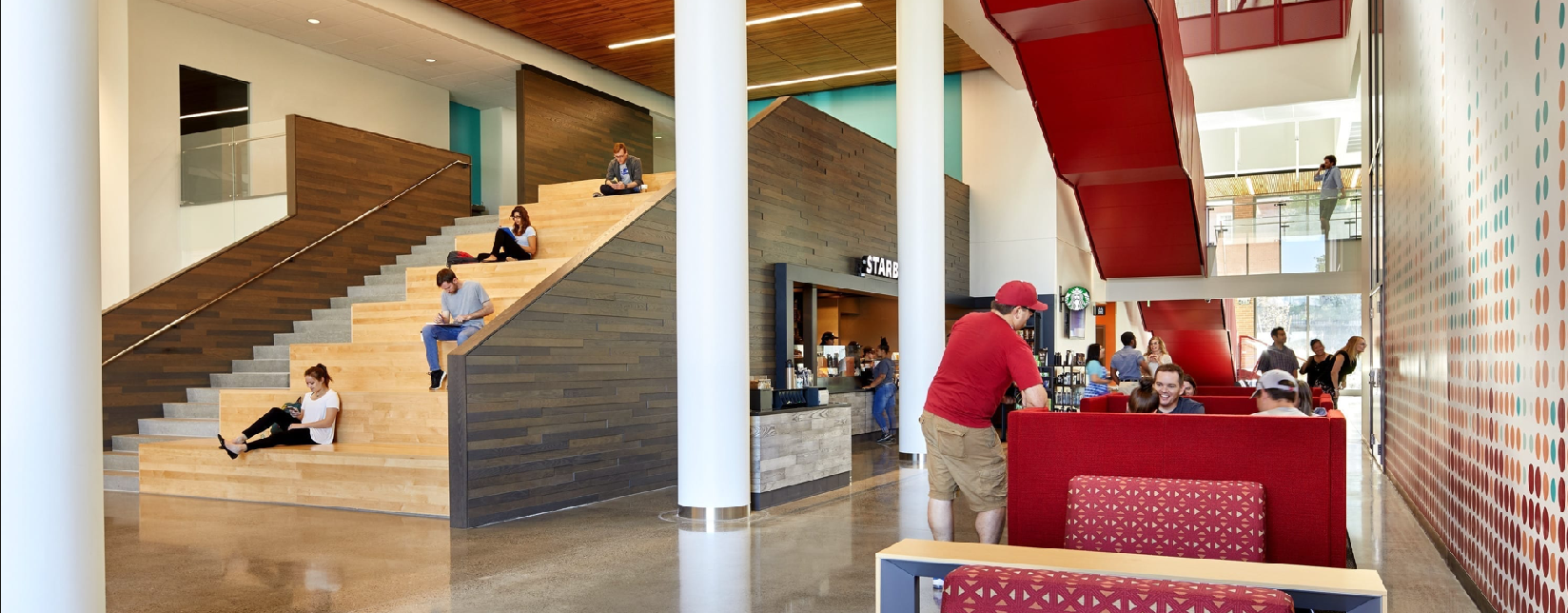
When looking at the SPARK from a spatial perspective, it is hard to suggest alternatives and suggestions to change the building’s spatial qualities. This is because the spark was very well planned. To dive into the different special areas let us start with the social areas. Every floor has a social or study area the biggest being on the ground floor. There is also two staircases that ensure that there will be no clogs on the stairs and plenty of hall space so people are not running into each other. Next there are a few different room types, the largest one being the classroom G010 which can accommodate large classes and it has a circular layout so that the one lecturing can hold the attention of the students. The next biggest classrooms are also on the ground floor and the spaces utilize the large space to allow for multiple desk groups to be formed with each one having a personal screen that shows lecture slides. The next sized of classrooms are on the second and third floor and mirror the ground floor classrooms layout wise but are smaller. Next there are small study rooms which allow for privacy. Overall the SPARK is a very comfortable building to be in as it accommodates to everyone’s spatial needs.
Envelope
System Grade: A
When looking at the SPARK building’s envelope it can easily be determined that it is composed of brick veneer and a lot of windows. The red brick is presumably used in-order to match the rest of the WSU campus as you will find this theme in almost every building. Overall it is a very visually pleasing design and the windows made of vision and spandrel glass allow for a huge amount of daylighting. Generally, when walking through the open areas of the SPARK during the day, you will not notice that indoor lights are being used. The walls being composed of brick, insulation, and structural steel help to keep in heat and keep out sound. So both acoustically and thermally this building is excellent in terms of design in the envelope.
Electrical Systems
System Grade: A
When looking at the electrical components of the SPARK there really is no reason to redesign this element. The electrical components are stacked floor to floor with the electrical room on the ground level and all the connections seem to have an organized a clean layout. We must understand that this is a new building and electrical design is getting more advanced and this building fits in with that description. The SPARK is very digitally inclined, and all the classrooms have some kind of media board or boards and speakers that help the class stay involved. The electrical system in the SPARK receives an “A” ranking.
Mechanical Systems
System Grade: B-
One mechanical system that our team has identified as being one of the most noticeable problems within the Spark building is the elevator system, it is slow and can be slightly noisy. We propose moving away from the chosen hydraulic elevator system and went with a Machine-Room-Less (MRL) elevator. This elevator system has four major benefits over the current system: it does not have a machine room meaning that the current area dedicated to that can be re-designed as a closet space or any other usable area. Next, the noise reduction in the MRL system is much better than the hydraulic system, therefore, occupants do not have to hear it all day in the building. Third, the MRL elevator is much faster than the hydraulic system; current occupants of the hydraulic elevator continually complain of how long it takes to move just one floor. Finally, the cost is much lower now that construction does not call for a cylinder to be driven into the ground for the piston to go into.
Lighting
System Grade: B
Our recommendation for improving the lighting throughout the building is to install Ambient Light Sensors (ALS) in addition to the motion detectors already installed. We observed that when we walked into well-lit rooms, by means of daylight, that the lights turn on because of the motion detectors without any regard for how well lit the room already may be. Instead, we believe that the installation of an ALS system, in conjunction with the motion detectors, won’t waste any extra energy and with these two systems working together, the requirements by the occupant to adjust the lighting as needed becomes almost minimal, depending on the circumstance.
Plumbing
System Grade: C+
While many people are on their way to fully automizing every aspect of a building for its occupants, one system seems to not have all the kinks worked out and is wasting people’s money for both energy usage and water usage. This system is the automatic flushing toilets. Have you ever had a toilet flush automatically without anyone using it or when you are not done using it, and then not flush once you are done? That is the problem with the auto-flush toilets, they do not seem to be a perfect system and it leads to unnecessary flushing, further increasing energy and water costs. Switching back to manual-flush toilets forces the system to only use water when it is needed so there is no more random flushes; also, using a manual system instead of an automated one reduces the energy costs to zero. One study from the EPA “claimed that about 26 percent (or 7 million) of the 27 million automatic-flush toilets around the country flushed at volumes higher than the federal standard, which is 1.6 gallons per flush… and that some flushed as much as 3.0 to 7.0 gpf.”[1]
[1] Konstantinovsky, M. (2018, January 22). Retrieved April 30, 2020, from https://science.howstuffworks.com/environmental/green-science/are-automatic-toilets-still-wasting-water.htm
Materials
System Grade: A
The Spark buildings current material system fits very well for the buildings use. The structural steel allowed for quick vertical installation as well as a few other benefits that were pointed out earlier in the case study on current systems. However, there are two minor material changes that we think would improve the acoustics in all of the study rooms, this would be the type of doors used, as well as eliminating an interior window on the inside of the study rooms. The door will be the most expensive solution in our proposal and we have chosen the IAC Acoustics Noise-Lock Door from Acoustical Solutions rated at STC 64 - their highest rated door. The door offers a tight seal around the frame with many different thicknesses and materials to satisfy desired aesthetics.As shown in the elevations below, the original plan shows a large window adjacent to the door of room 315 in the Spark building. In order to improve acoustics in the room and block outside noise, our company is proposing the new plan shown on the right in the below elevations. This proposal extends the FT03 wall all the way through to the door, eliminating the interior window completely. These improvements would significantly boost the acoustical control in these areas.
Building Controls
System Grade: A